


FE Pilot Pressure Booster
Air-over-oil pressure intensifier that supplies pilot pressure for reliable sealing on FE threaded and irregular-surface applications.
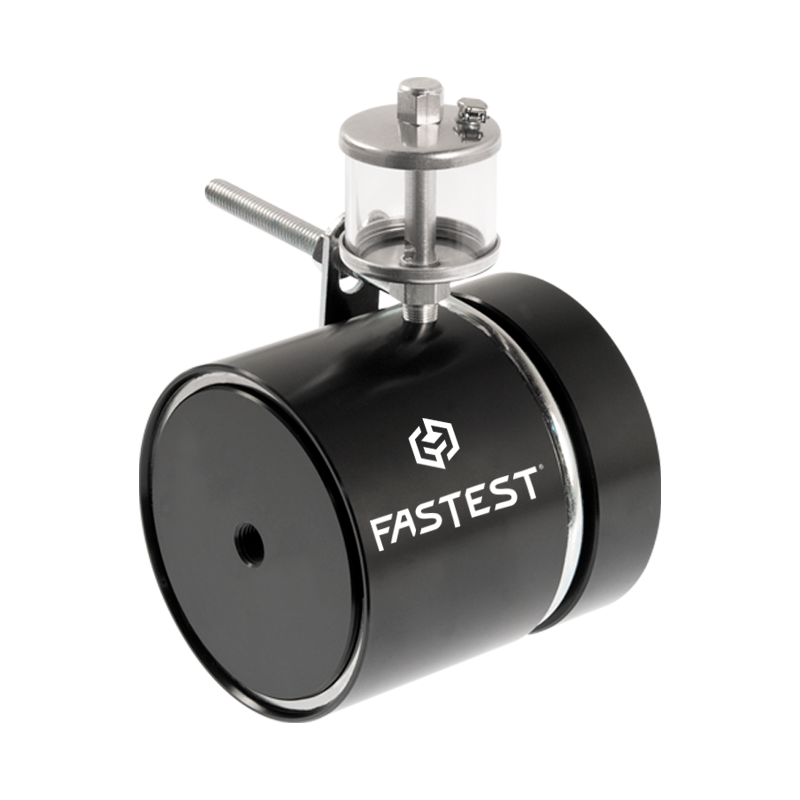
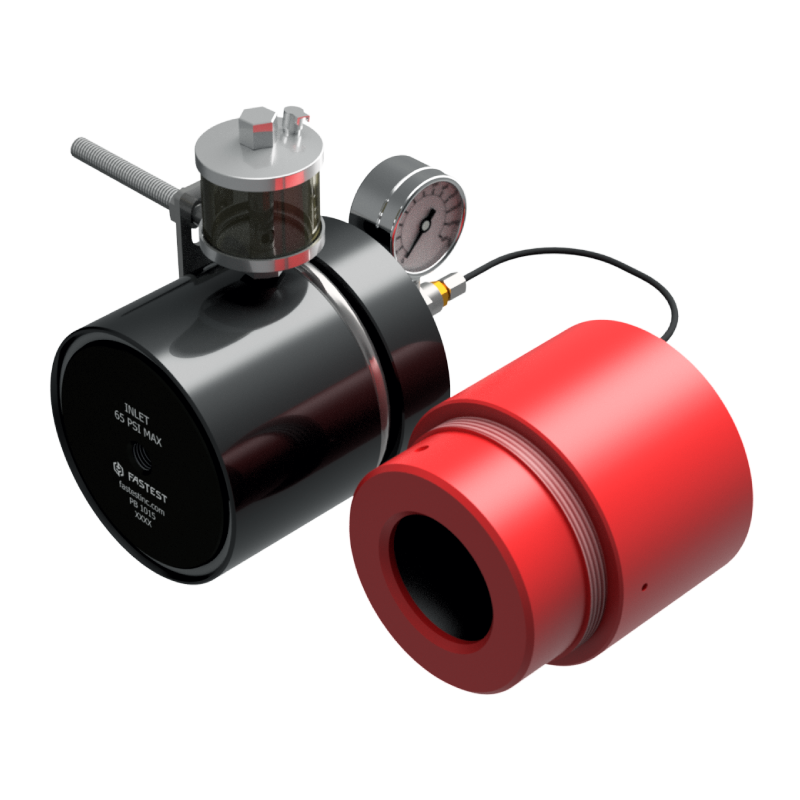
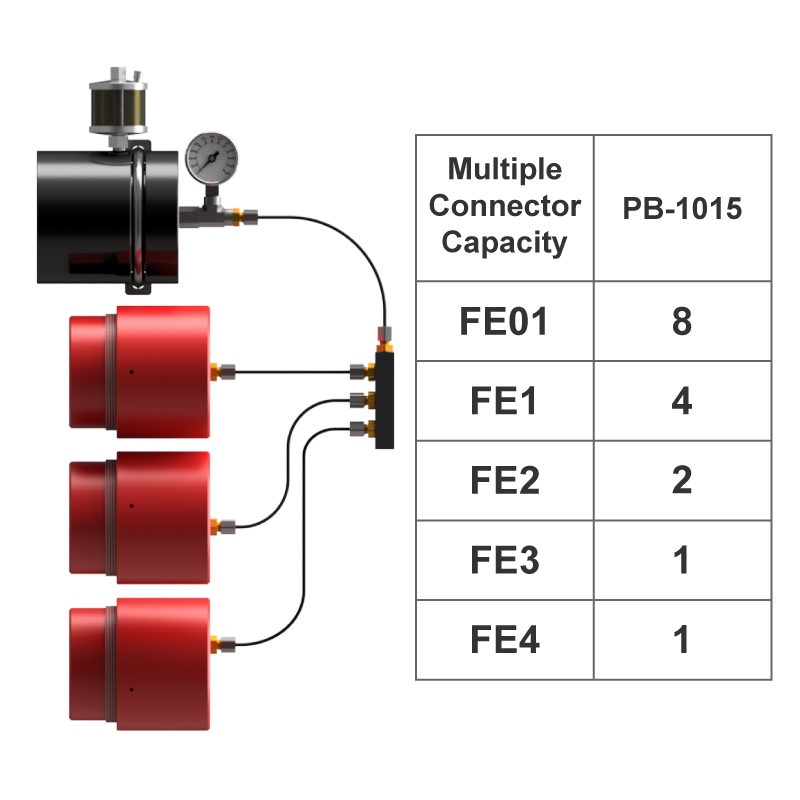
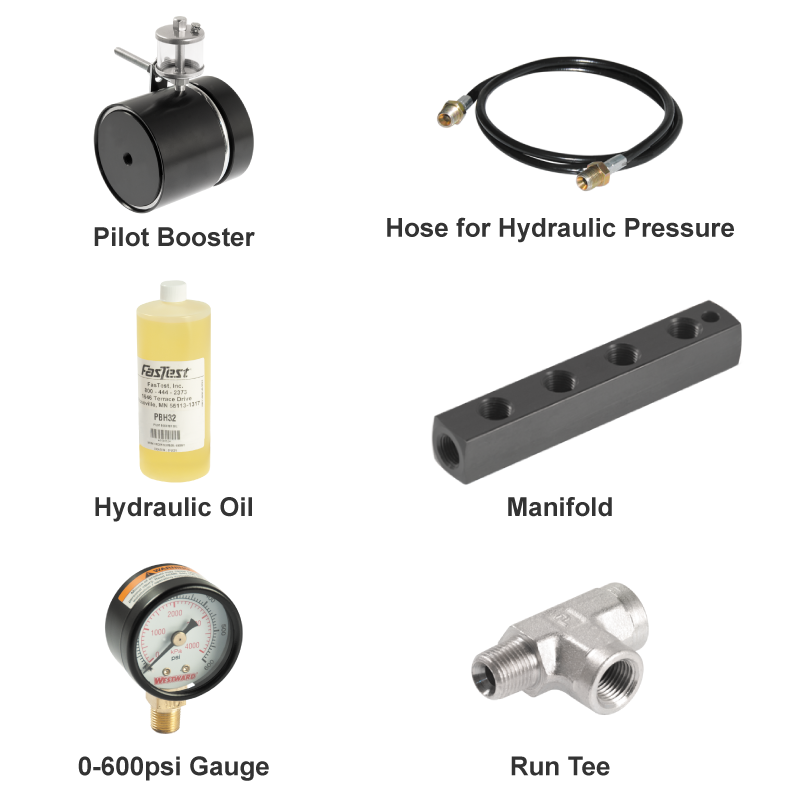
A sealing system consisting of an FE Connector, urethane main seal and PB1015 Pressure Booster can produce the seal movement and long life performance needed in production testing applications. 30-65psi (2.1-4.5bar) air required.
Urethane sealing material is superior to neoprene material in high pressure, high abrasion and high cycle applications. The increased elastomer movement required for sealing irregular shapes or into threads requires urethane seal material. Up to 600 psi (41.4 bar) pilot pressure is needed to seal deep root external threads. Production testing of threads and hard to seal surfaces can now be automated using the Pilot Pressure Booster and a proper sized urethane seal set in a FE Series Connector.
DO NOT use the booster with the FI Series connectors due to lower pressure rating.
Pilot Booster Operating Instructions: Click Here
Pilot Booster Repair Kit: Click Here
Similar Products
FE External Sealing Connection Tool
Pneumatic seal-only connector for fast leak-tight external connections to tubes and threads in automated and semi-automated test processes.
FEG External Cradle Connection Tool
Pneumatic external sealing tool with a custom cradle for flanged ports turbo housings and irregular profiles.
The Internal Gas Connector That Shuts Itself Off on Disconnect
The FasTest GasMate GZNV is a lever-actuated internal connector that seals into NPT and BSPP (G) / BSPT internal threads for natural gas and burner testing at up to 5 psi (0.345 bar). It is built for gas-fired appliance and furnace production testing, where connections are made and broken continuously on lines carrying combustible gas.
Gas safety on a test line has two halves: do not provide an ignition source, and do not release fuel. The GZNV is unusual in addressing both. Non-sparking aluminum and brass components handle the first — neither material throws sparks on impact the way ferrous metals can, and repeated connection and disconnection is exactly where that contact occurs. The internal shut-off valve handles the second: moving the handle to the disconnected position stops the flow of gas, so the connector closes itself before it comes off the port.
That second feature is worth dwelling on, because it changes what happens in the most common failure scenario. Without it, disconnecting a still-live gas connection vents gas into the workspace, and the only thing preventing that is the operator following procedure. With the shut-off valve built into the connector, the act of disconnecting is itself the act of shutting off — the two cannot be performed out of order.
An adjustable ring lets the FasTest GasMate GZNV accommodate a wide range of sealing sizes rather than requiring a precise match to each port, which matters where thread condition and tolerance vary across suppliers and production batches. Its external counterpart is the GasMate® G60V, which seals on the outside of male NPT threads at up to 30 psi.
The Problem the FasTest GasMate GZNV Solves
Leak testing gas-fired appliances at the port creates a specific combination of problems:
-
Disconnecting can release gas: If a connection comes off while gas is still flowing, gas vents into the workspace. Relying on the operator to shut off upstream before disconnecting leaves a hazard that depends entirely on procedure being followed every time.
-
The atmosphere may be combustible: Connections are made and broken where natural gas can be present, so tooling that can generate a spark on contact introduces an ignition risk in exactly the place where contact happens most.
-
Gas port threads vary: Thread tolerance and condition differ between suppliers and batches. A connector that needs a precise match either fails to seal on the outliers or requires several size-specific tools on the bench.
-
Test pressures are very low: At 5 psi there is almost no pressure available to help energise a seal, so the sealing mechanism has to do the work on its own — a connector designed around high-pressure assumptions is not the right tool for the job.
The FasTest GasMate GZNV addresses each: an internal shut-off valve stops flow as the handle moves to disconnect, non-sparking aluminum and brass components remove the ignition path, an adjustable ring accommodates a wide sealing range, and the tool is purpose-built for the low pressures gas appliance testing actually uses.
Key Features
Internal Shut-Off Valve Stops Gas Flow on Disconnect
The FasTest GasMate GZNV has an internal shut-off valve that stops the flow of gas when the handle is in the disconnected position. This is the feature that most distinguishes it. On a gas test line, the dangerous moment is disconnection — and building the shut-off into the connector means the operator cannot disconnect without also shutting off, because the same handle movement does both. Rather than depending on procedure to prevent a gas release, the tool makes the two actions inseparable.
Non-Sparking Aluminum and Brass Components
The GZNV is built with non-sparking aluminum and brass components. In a test environment where natural gas may be present, materials that can generate a spark on impact introduce an ignition risk, and the point of repeated contact between tool and part is precisely where that risk concentrates. Using non-sparking materials through the connector removes that path at the place it matters most.
Adjustable Ring for a Wide Sealing Range
An adjustable ring allows the FasTest GasMate GZNV to accommodate a wide range of sealing sizes from a single connector. Gas port threads vary in tolerance and condition between suppliers and production batches, and a connector that has to match each one precisely either struggles on the outliers or multiplies into several size-specific tools. The adjustable ring lets one tool cover the range instead.
Built for Gas-Fired Appliance and Furnace Testing
Every design decision in the FasTest GasMate GZNV follows from its application. Gas-fired appliance and furnace lines test at very low pressure, in high volume, on internal NPT and BSPP/BSPT gas ports, in an environment where combustible gas is part of the process — which is why the connector is rated to 5 psi, uses non-sparking materials, seals across a wide range, and shuts itself off on disconnect.
Technical Specifications
| Specification | Detail |
|---|---|
| Product Type | Internal, lever-actuated connector for natural gas and burner testing. |
| Connects To | NPT internal | BSPP (G) / BSPT internal. |
| Max Pressure Rating | Vacuum to 5 psi (0.345 bar). |
| Actuation Method | Lever handle. |
| Actuation Type | Internal threaded connection for gas burner testing. |
| Safety — Gas Isolation | Internal shut-off valve stops the flow of gas when the handle is in the disconnected position. |
| Safety — Materials | Non-sparking aluminum and brass components. |
| Sealing Range | Adjustable ring accommodates a wide range of sealing sizes. |
| Thread Sealant | None required — the connector seals on its own seal element rather than on tape or pipe dope. |
| Designed For | Leak testing and other related processes. |
| Related Product | GasMate® G60V — external connections for natural gas and burner testing (30 psi/2.1 bar). |
| Target Industry | Appliance — gas-fired appliance, furnace, and burner manufacturing. |
| Documentation | GZNV datasheet, operating instructions, main seal replacement, and rebuild/repair instructions. |
Where the FasTest GasMate GZNV Is Used
Gas-Fired Appliance Production Testing
Gas-fired appliances are leak tested at the end of assembly, in volume, on internal gas ports. The FasTest GasMate GZNV makes that connection in seconds without tape or sealant, shuts off gas as it disconnects, and keeps the tooling non-sparking in an environment where gas is part of the test.
Furnace and Burner Assembly Testing
Furnace and burner assemblies present internal NPT and BSPP/BSPT gas ports that require leak testing before the unit ships. The GZNV seals into those ports at up to 5 psi, with the adjustable ring absorbing the thread variation that comes with mixed suppliers.
Internal Gas Port Leak Testing
Anywhere an internal gas thread has to be leak tested repeatedly, the FasTest GasMate GZNV replaces the threaded test fitting — removing the sealant, the wrenching, and the thread wear that accumulates over hundreds of test cycles on the same port.
Test Environments Requiring Non-Sparking Tooling
Where the test environment calls for non-sparking tooling, the GZNV’s aluminum and brass construction makes it appropriate for the application in a way that a ferrous-component connector would not be. Confirm the specific requirements of your facility and application with FasTest when specifying.
FasTest GasMate GZNV vs. a Threaded Internal Test Fitting
| Threaded Internal Test Fitting | FasTest GasMate GZNV | |
|---|---|---|
| Gas Release on Disconnect | Gas vents unless shut off upstream first | Internal shut-off valve stops flow on disconnect |
| Sparking Risk | Steel fittings and wrenches can spark | Non-sparking aluminum and brass components |
| Thread Sealant | Tape or pipe dope at every connection | None — seals on its own seal element |
| Thread Variation | One fitting per thread size and tolerance | Adjustable ring covers a wide sealing range |
| Connection Time | Wrench in, wrench out | Seconds — one lever motion |
| Port Wear | Repeated threading wears the gas port | No threading — seals without engaging threads |
| Consumables | Fresh sealant every connection | None |
| Repeatability | Varies with torque and sealant application | Consistent lever-actuated connection |
Frequently Asked Questions
Q: What is the FasTest GasMate GZNV?
A: The FasTest GasMate GZNV is a lever-actuated internal connector for natural gas and burner testing, sealing into NPT and BSPP (G) / BSPT internal threads at up to 5 psi (0.345 bar). It uses non-sparking aluminum and brass components and includes an internal shut-off valve.
Q: What does the internal shut-off valve do?
A: It stops the flow of gas when the handle is in the disconnected position. Because the same handle movement both disconnects the tool and closes the valve, the connector cannot be removed while gas is still flowing — the two actions cannot be performed out of order.
Q: Why does the GZNV use non-sparking materials?
A: Because gas appliance testing takes place where combustible gas may be present, and a component that can generate a spark on impact introduces an ignition risk. Aluminum and brass are non-sparking, and using them through the connector removes that risk at the point where the tool repeatedly contacts the part.
Q: What does the GasMate GZNV connect to?
A: Internal NPT threads and internal BSPP (G) / BSPT threads — the gas port threads found on gas-fired appliances, furnaces, and burner assemblies.
Q: What is the adjustable ring for?
A: It lets the connector accommodate a wide range of sealing sizes from a single tool. Gas port threads vary in tolerance and condition between suppliers and batches, and the adjustable ring absorbs that variation instead of requiring a size-specific connector for each case.
Q: What is the maximum pressure rating of the GZNV?
A: Vacuum to 5 psi (0.345 bar) — the low-pressure range used for natural gas appliance, furnace, and burner leak testing.
Q: Does the GasMate GZNV need thread tape or sealant?
A: No. It seals on its own seal element rather than on tape or pipe dope, so there is no consumable to reapply between parts and nothing introduced into the gas path.
Q: What is the difference between the GasMate GZNV and the GasMate G60V?
A: They work opposite sides of the connection. The GZNV seals into internal NPT and BSPP/BSPT threads at up to 5 psi (0.345 bar), is lever actuated, and includes an internal shut-off valve. The G60V seals onto external male NPT threads at up to 30 psi (2.1 bar), is sleeve actuated, and uses a floating piston with an optional SureConnect™ sleeve. Choose the GZNV for internal gas ports and the G60V for external NPT threads.
Q: How is the GasMate GZNV actuated?
A: By lever handle. One motion makes the connection, and returning the handle to the disconnected position both releases the tool and closes the internal shut-off valve.
Q: What industries use the GasMate GZNV?
A: Appliance manufacturing — specifically gas-fired appliance, furnace, and burner production, where internal gas ports are leak tested in volume and non-sparking tooling is required.