


ZeroMax™ | MBE Leak Test Tool
Leak test tool for fast repeatable connections to ZeroMax™ | access ports in OEM processing.
The NEW ZeroMax™ System eliminates the need for Process "Stub" Tubes or crimp type capping systems and their associated crimping & welding equipment. OEM's and Service Technicians now have an easy, repeatable system access for rework, service and end-of-life refrigerant recovery that doesn't leak.
ZeroMax™ assures a hermetic, Zero-Leakage seal by incorporating FasTest's patent pending Access Port technology and Mazimizes Accessibility.
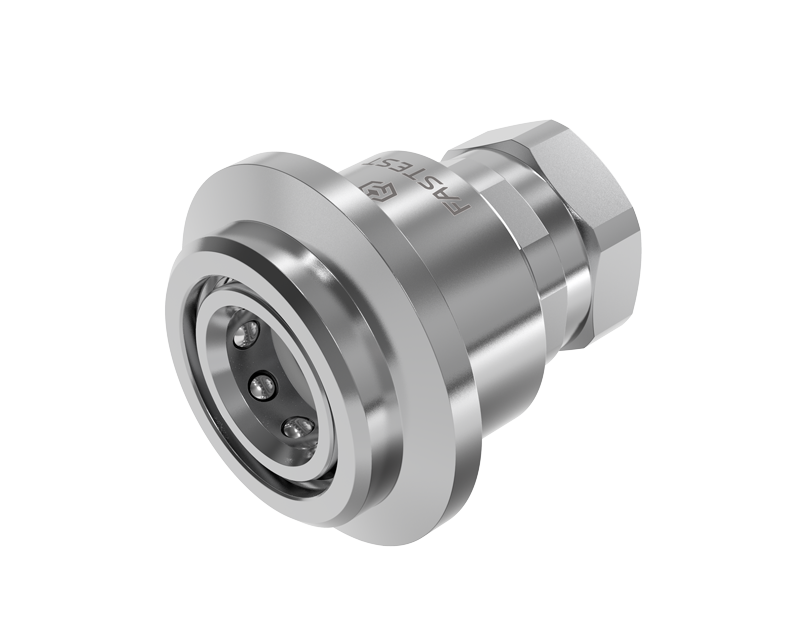
ZeroMax™ MBE Leak Test Tool (CMPT10)
Ball latching connector, valveless design to maximize flow. Connect to Seat at Leak Test station to pressurize and relieve testing gas.
- Ergonomic ball & sleeve action
- Safety Latch system will not disconnect under pressure
- 1/4 NPT media port
ZeroMax™ Brochure: Click Here
ZeroMax™ MBE Leak Test Tool Operating Instructions: Click Here
ZeroMax™ MBE Leak Test Tool Seal Replacement: Click Here
ZeroMax™ System Guide: Click Here
Similar Products
ZeroMax™ | Refrigerant Access Ports
Zero-leak refrigerant access port system that eliminates process stub tubes while maintaining hermetic sealing.
ZeroMax™ | Traveler Tool
Installation and processing tool for consistent placement and access of ZeroMax™ | port components.
ZeroMax™ | MBV Evacuation Tool
Evacuation tool for efficient system evacuation through ZeroMax™ | access ports.
ZeroMax™ | RQD Charge Tool
Charge tool for fast refrigerant charging through ZeroMax™ | access ports.
Valveless by Design — Maximum Flow for Fast Leak Testing
The FasTest ZeroMax™ MBE Leak Test Tool (CMPT10) is the leak-test tool of the ZeroMax™ system. It is a ball latching connector that connects to the ZeroMax™ seat at the leak test station to pressurize the system with testing gas and then relieve it — making fast, repeatable connections to ZeroMax™ access ports in OEM processing.
Its defining feature is that it is valveless, a deliberate choice that maximizes flow. A leak test is a cycle of pressurizing and relieving, and the faster the system reaches test pressure and vents afterward, the shorter the cycle. An internal valve is a restriction in that path, so the MBE simply does not have one — the opposite decision from the ZeroMax™ RQD Charge Tool, which uses a lever-operated valve to control charging. For leak testing, where flow control is not needed but speed is, valveless is the right trade, and it is what makes this a high-flow leak test tool rather than a general connection.
A safety latch system prevents the tool from being disconnected while the system is under pressure — the feature that matters most on a leak test station, where the whole job is holding the system at test pressure. A connection that could release mid-test would be both a safety hazard and an aborted test; the latch makes that mechanically impossible rather than a matter of operator care.
The tool belongs to the ZeroMax™ system, which eliminates the process “stub” tubes and crimp-type capping that conventional leak testing works around — along with the crimping and welding equipment those require. An ergonomic ball & sleeve action makes the connection fast and repeatable at production volumes, and a 1/4 NPT media port carries the testing gas. It is one of the ZeroMax™ tools, alongside the Traveler, MBV Evacuation, and RQD Charge tools.
The Problem the FasTest ZeroMax™ MBE Leak Test Tool Solves
Leak testing a sealed refrigerant system, in volume, raises problems the ZeroMax™ system and this tool are built to remove:
-
Flow restriction slows the test: A leak test pressurizes and relieves on every unit. A valve or a narrow path in the connection lengthens both steps — so the MBE is valveless, to maximize flow and keep the cycle short.
-
The connection must hold under pressure: A leak test holds the system at test pressure by definition. A connection that could disconnect while pressurized is a hazard and a failed test, which is why the safety latch keeps it locked on.
-
Process stub tubes get in the way: Conventional access relies on a process tube that is crimped and welded shut — extra equipment and a closure that has to be cut open to re-access. ZeroMax™ replaces it with a re-accessible zero-leak port.
-
High volume needs repeatable connection: On a line where every unit is leak tested, the connection has to be fast and consistent hundreds of times a shift — hence the ball latching, ball & sleeve action.
The ZeroMax™ MBE Leak Test Tool answers each: a valveless design maximizes flow for fast pressurize-and-relieve, the safety latch keeps it connected under pressure, it works through a re-accessible ZeroMax™ port instead of a crimped stub tube, and ball latching makes the connection quick and repeatable.
Key Features
Valveless Design — Maximum Flow
The MBE is valveless, and that is a deliberate design choice to maximize flow. In leak testing, the tool pressurizes the system with testing gas and then relieves it, and any valve in the flow path slows both. Removing the valve gives the highest flow the connection can carry — shorter time to test pressure, faster relief afterward, and a shorter cycle on a line where every unit is tested. It is the single feature that most distinguishes the MBE from the valved RQD Charge Tool, and it is what “high-flow leak test tool” refers to.
Safety Latch System — Will Not Disconnect Under Pressure
The safety latch system prevents the tool from being disconnected while the system is under pressure. On a leak test station this is the essential safety feature: the unit is held at test pressure throughout, so a connection that could release mid-test would be both dangerous and an aborted test. The latch removes that possibility mechanically.
Ball Latching Connection to the Seat
The tool latches onto the ZeroMax™ seat at the leak test station with a ball latching mechanism. The connection is positive and quick, which is what allows a leak test station to keep pace with the line.
Ergonomic Ball & Sleeve Action
An ergonomic ball & sleeve action makes the connection in one controlled motion, sparing the operator repetitive effort across a shift of testing and keeping each connection consistent.
1/4 NPT Media Port
A 1/4 NPT media port carries the testing gas through the tool, pressurizing the system for the test and relieving it afterward.
Technical Specifications
| Specification | Detail |
|---|---|
| Product Type | Valveless, high-flow leak test tool for ZeroMax™ access ports. |
| Part Number | CMPT10 |
| Flow Design | Valveless — no internal valve, to maximize flow. |
| Function | Pressurize and relieve testing gas. |
| Safety | Safety latch system — will not disconnect under pressure. |
| Actuation Method | Ball latching connector with ergonomic ball & sleeve action. |
| Media Port | 1/4 NPT. |
| System Role | One of the ZeroMax™ tools — alongside the Traveler Tool (installation/placement), the MBV Evacuation Tool (evacuation), and the RQD Charge Tool (charging) — all working with ZeroMax™ Refrigerant Access Ports. |
| Target Industry | HVAC-R and refrigerant systems manufacturing — OEM leak test stations, plus rework and service. |
Where the FasTest ZeroMax™ MBE Leak Test Tool Is Used
OEM Leak Test Stations
Its primary home is the leak test station on a production line: latch onto the ZeroMax™ seat, pressurize with testing gas, hold and measure, then relieve. The valveless, high-flow design keeps the pressurize-and-relieve cycle short on a line where every unit is tested.
Pressure and Proof Testing
For pressure and proof testing, the safety latch is what lets the system be taken to and held at test pressure safely, with the tool locked on for the duration and released only once the system is relieved.
Rework and Service Verification
Because the ZeroMax™ port stays re-accessible, a unit that has been reworked or serviced can be leak tested again through the same port — no crimped stub tube to open and reseal. The MBE makes that re-test as quick as the original.
HVAC-R and Refrigerant Systems Manufacturing
The tool belongs to the ZeroMax™ refrigerant access system, so its home is HVAC-R and refrigerant systems — air conditioning, refrigeration, and heat pump production — where sealed systems are leak tested in volume through ZeroMax™ access ports.
FasTest ZeroMax™ MBE Leak Test Tool vs. a Standard Valved Leak Test Connection
| Standard Valved Connection | ZeroMax™ MBE Leak Test Tool | |
|---|---|---|
| Flow Path | Valve restricts flow | Valveless — maximum flow |
| Time to Test Pressure | Slower through the valve | Faster — high flow |
| Relieving Test Gas | Slower | Faster — high flow |
| Under Pressure | May be released | Safety latch — will not disconnect |
| Connection | Thread or varies | Ball latching, ergonomic ball & sleeve |
| Access Port | Process tube / crimped closure | ZeroMax™ zero-leak, re-accessible |
| Re-Test After Rework | Open and reseal the tube | Reconnect to the same port |
Frequently Asked Questions
Q: What is the ZeroMax MBE Leak Test Tool?
A: It is the leak-test tool of the FasTest ZeroMax™ system, part number CMPT10. A ball latching connector with a valveless, high-flow design, it connects to the ZeroMax™ seat at the leak test station to pressurize the system with testing gas and then relieve it.
Q: Why is the MBE valveless?
A: To maximize flow. A leak test is a cycle of pressurizing and relieving, and a valve in the flow path slows both. Removing it gives the highest flow the connection can carry, which shortens the test cycle. Flow control is not needed for leak testing, so the valve is left out — unlike the RQD Charge Tool, where a valve is used to control charging.
Q: What does the MBE connect to?
A: The ZeroMax™ seat, at the leak test station. It latches on with a ball latching mechanism, pressurizes the system with testing gas for the leak test, and relieves it afterward.
Q: Can the MBE disconnect under pressure?
A: No. The safety latch system prevents disconnection while the system is under pressure — which is essential on a leak test station, where the unit is deliberately held at test pressure.
Q: What does the MBE pressurize with?
A: Testing gas — it pressurizes the system with the test medium and relieves it after the test. (It is a leak test tool, so it handles testing gas rather than refrigerant; refrigerant charging is the RQD Charge Tool’s job.)
Q: What is the difference between the ZeroMax MBE Leak Test Tool and the RQD Charge Tool?
A: They are the leak-test and charge tools of the ZeroMax™ system. The MBE is valveless to maximize flow, and pressurizes and relieves testing gas at the leak test station. The RQD has a lever-operated internal valve to control refrigerant charging at the charge station, and requires activating recovery before disconnecting. Both use ball latching and a safety latch. Choose the MBE for leak testing and the RQD for charging.
Q: Is this MBE the same as the CoreMax MBE or the MBE / MRE connector?
A: No. Several FasTest products share the letters “MBE.” This is the ZeroMax™ MBE Leak Test Tool, for ZeroMax™ access ports. There is also a CoreMax® MBE Leak Test Tool (for CoreMax® valves) and an unrelated MBE / MRE expanded-tube connector. Make sure you are on the ZeroMax™ page if you are working with the ZeroMax™ system.
Q: Is the MBE a quick-connect coupling?
A: It is a reusable leak test tool rather than a permanent coupling. It makes a fast ball latching connection to a ZeroMax™ seat for leak testing, with a safety latch, and releases once the system is relieved — it is tooling, not a fitting that stays on the product.
Q: What pressure can the MBE test to?
A: The product page does not currently state a maximum pressure rating. It should be confirmed with FasTest for the MBE specifically rather than assumed, since the rating defines what it can be used to test.
Q: What industries use the ZeroMax MBE Leak Test Tool?
A: HVAC-R and refrigerant systems — air conditioning, refrigeration, and heat pump manufacturing — where sealed systems are leak tested in volume through ZeroMax™ access ports, including after rework and service.