


ZeroMax™ | RQD Charge Tool
Charge tool for fast refrigerant charging through ZeroMax™ | access ports.
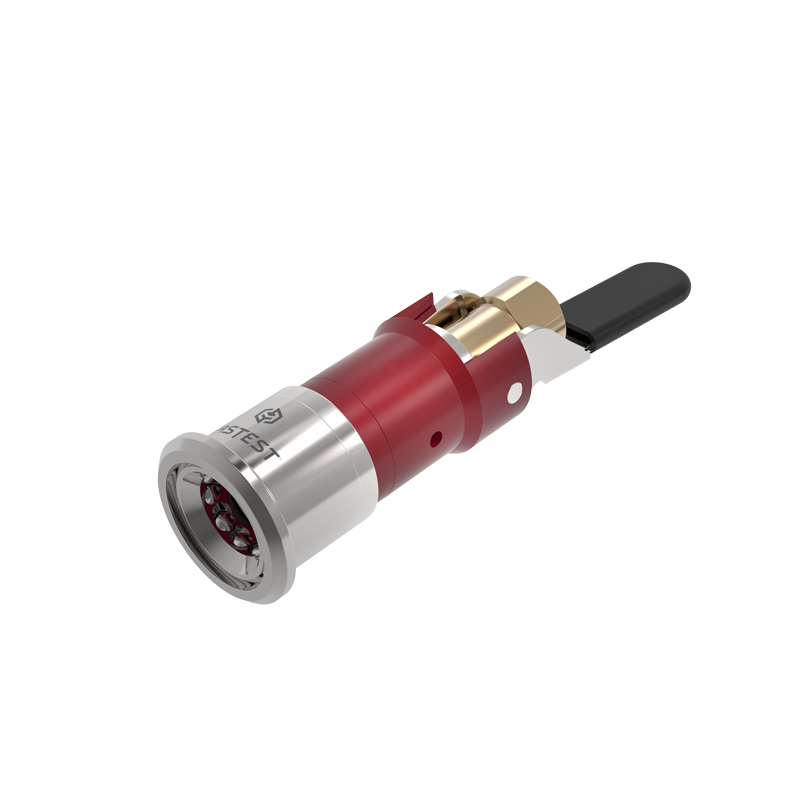
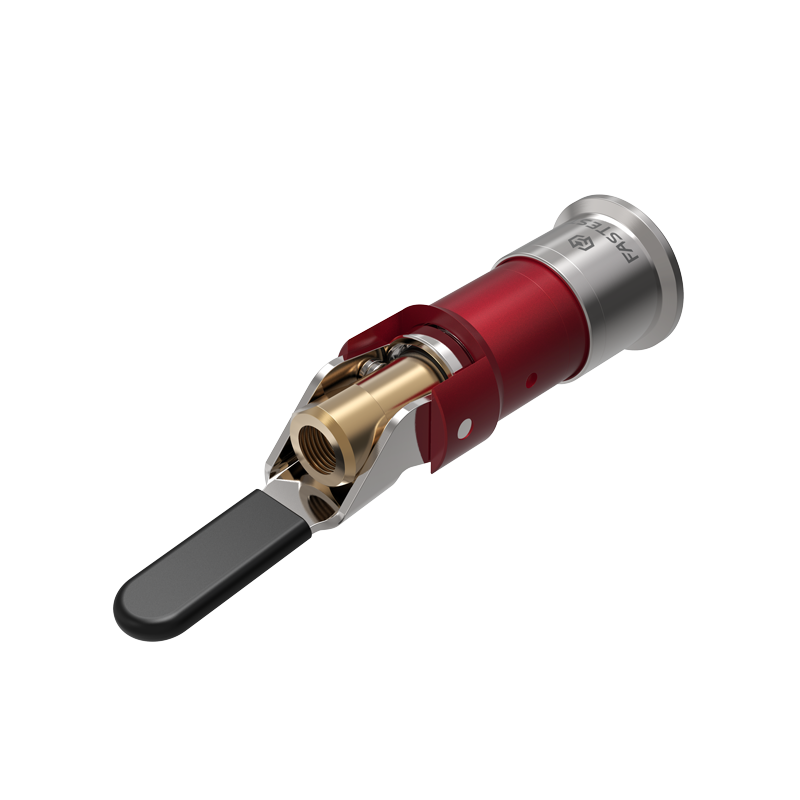
The NEW ZeroMax™ System eliminates the need for Process "Stub" Tubes or crimp type capping systems and their associated crimping & welding equipment. OEM's and Service Technicians now have an easy, repeatable system access for rework, service and end-of-life refrigerant recovery that doesn't leak.
ZeroMax™ assures a hermetic, Zero-Leakage seal by incorporating FasTest's patent pending Access Port technology and Mazimizes Accessibility.
ZeroMax™ RQD Charge Tool (CMPT30)
Ball latching connector with a lever operated internal valve allows easy connection to Traveler. Connect at Charge station to fill refrigerant into system. Activate refrigerant recovery system prior to disconnecting RQD tool from Traveler to prevent refrigerant escape to atmosphere.
- Ergonomic ball & sleeve action
- Safety Latch system will not disconnect under pressure
- 1/4 NPT media port
ZeroMax™ Brochure: Click Here
ZeroMax™ RQD Charge Tool Operating Instructions: Click Here
ZeroMax™ RQD Charge Tool Rebuild Instructions: Click Here
ZeroMax™ System Guide: Click Here
Similar Products
ZeroMax™ | Refrigerant Access Ports
Zero-leak refrigerant access port system that eliminates process stub tubes while maintaining hermetic sealing.
ZeroMax™ | MBE Leak Test Tool
Leak test tool for fast repeatable connections to ZeroMax™ | access ports in OEM processing.
ZeroMax™ | Traveler Tool
Installation and processing tool for consistent placement and access of ZeroMax™ | port components.
ZeroMax™ | MBV Evacuation Tool
Evacuation tool for efficient system evacuation through ZeroMax™ | access ports.
Which RQD option is best for you?
Use the RQD options page to learn more.
Charge Refrigerant Through a Port That Doesn’t Have to Be Crimped Shut
The FasTest ZeroMax™ RQD Charge Tool (CMPT30) is the charge-station tool of the ZeroMax™ system. It is a ball latching connector with a lever-operated internal valve that connects to a ZeroMax™ Traveler, so refrigerant can be filled into the system quickly and repeatably at the charge station.
Its value comes from what the ZeroMax™ system replaces. Conventionally, a sealed refrigerant system is accessed through a process “stub” tube that is crimped and welded shut after charging — which requires crimping and welding equipment on the line, and leaves a closure that has to be cut open and re-sealed if the unit is ever reworked or serviced. ZeroMax™ eliminates the stub tube and crimp-type capping entirely, along with the equipment behind it, and gives OEMs and service technicians repeatable access for rework, service, and end-of-life refrigerant recovery through a port that does not leak.
That is what makes this a charge tool rather than a generic filling connector: it is designed for a system where the access port stays serviceable for the life of the product. FasTest states that ZeroMax™ assures a hermetic, zero-leakage seal through its access port technology — so the same port used to charge the unit on the line can be used again years later to recover refrigerant at end of life, without the cut-and-recrimp cycle.
On the tool itself, a safety latch system prevents disconnection under pressure, an ergonomic ball & sleeve action makes the connection fast and repeatable at production volumes, and a 1/4 NPT media port carries the refrigerant. The lever-operated internal valve gives the operator direct control of when flow is open, rather than flow being tied to the connection alone.
The Problem the FasTest ZeroMax™ RQD Charge Tool Solves
Charging a hermetically sealed refrigerant system creates a set of problems the ZeroMax™ system is built to remove:
-
Stub tubes need crimping and welding equipment: The conventional process tube must be crimped and welded closed after charging — capital equipment, floor space, and a process step on every unit.
-
A crimped tube is not serviceable: Once crimped and welded, re-accessing the system for rework, service, or recovery means cutting it open and re-sealing it. ZeroMax™ leaves a port that can simply be reconnected to.
-
End-of-life recovery has to be possible: Refrigerant must be recovered rather than vented when a unit is retired. That is far easier through a re-accessible port than through a sealed stub.
-
The connection must not release under pressure: Charging means the system is pressurised. A connection that could come off mid-charge is a hazard and a refrigerant release.
-
Disconnection must not vent refrigerant: Any charge tool that is pulled off a live system without recovery releases refrigerant to atmosphere — which is why the operating sequence matters as much as the hardware.
The ZeroMax™ RQD Charge Tool addresses these: it charges through a re-accessible zero-leak port instead of a crimped stub, the safety latch keeps it connected under pressure, and the documented sequence — activate the recovery system before disconnecting — keeps refrigerant out of the atmosphere.
Key Features
Ball Latching Connector With Lever-Operated Internal Valve
The tool latches onto the ZeroMax™ Traveler with a ball latching mechanism, and a lever-operated internal valve controls flow through the tool. Separating the two — latch first, then open the valve — gives the operator direct control over when refrigerant flows, rather than flow starting the instant the connection is made.
Safety Latch System — Will Not Disconnect Under Pressure
The safety latch system prevents the tool from being disconnected while the system is under pressure. On a charge station that matters directly: the unit is pressurised with refrigerant by definition, so a connection that could release mid-charge would be both a safety hazard and a refrigerant release. The latch makes that mechanically impossible rather than procedurally discouraged.
Ergonomic Ball & Sleeve Action
An ergonomic ball & sleeve action makes the connection in one controlled motion. On a charge station handling every unit that comes down the line, that keeps cycle time short and spares the operator the repetitive effort of a threaded connection.
1/4 NPT Media Port
A 1/4 NPT media port carries refrigerant through the tool from the charging equipment into the system.
Refrigerant Recovery Before Disconnection
FasTest specifies that the refrigerant recovery system is activated before the RQD tool is disconnected from the Traveler, to prevent refrigerant escaping to atmosphere. This is part of how the tool is meant to be operated, not an optional practice — it protects both the operator and the environment, and it reflects the regulatory expectation that refrigerant is recovered rather than vented. Follow the operating instructions for the full sequence.
Technical Specifications
| Specification | Detail |
|---|---|
| Product Type | Charge-station tool for refrigerant charging through ZeroMax™ access ports. |
| Part Number | CMPT30. |
| Connects To | ZeroMax™ Traveler / ZeroMax™ access port. |
| Actuation Method | Ball latch, lever actuation. |
| Valve Control | Lever-operated internal valve. |
| Safety | Safety latch system — will not disconnect under pressure. |
| Media Port | 1/4 NPT. |
| Operating Requirement | Activate the refrigerant recovery system before disconnecting the RQD tool from the Traveler, to prevent refrigerant escaping to atmosphere. |
| System Role | One of the ZeroMax™ tools — alongside the Traveler Tool (installation/placement), the MBV Evacuation Tool (evacuation), and the MBE Leak Test Tool (leak testing) — all working with ZeroMax™ Refrigerant Access Ports. |
| Target Industry | HVAC-R and refrigerant systems manufacturing and service — OEM charge stations, plus rework, service, and end-of-life recovery. |
| Documentation | ZeroMax™ brochure, RQD Charge Tool operating instructions, rebuild instructions, and the ZeroMax™ System Guide. |
Where the FasTest ZeroMax™ RQD Charge Tool Is Used
OEM Charge Stations
Its primary home is the charge station on a production line: connect to the Traveler, open the lever valve, fill the system with refrigerant, close and disconnect following the recovery sequence. Ball latching keeps the connection fast and repeatable across every unit built.
Rework
When a unit needs to be re-accessed after charging — to correct a charge or address a fault — the ZeroMax™ port is simply reconnected to. There is no crimped stub tube to cut open and re-seal, which is the practical benefit of the system for anyone dealing with rework volume.
Field Service
Service technicians use the same access route as the factory. Because the ZeroMax™ port stays hermetic and re-accessible for the life of the unit, servicing does not begin with opening up a sealed process tube.
End-of-Life Refrigerant Recovery
At end of life, refrigerant must be recovered rather than released. A permanently re-accessible zero-leak port makes that straightforward — and it is one of the stated reasons the ZeroMax™ system exists, alongside eliminating the stub tube in the first place.
ZeroMax™ Charging vs. a Crimped Process Stub Tube
| Process “Stub” Tube | ZeroMax™ with RQD Charge Tool | |
|---|---|---|
| Closing the System | Crimp and weld after charging | Hermetic zero-leak access port |
| Equipment Needed | Crimping and welding equipment | No crimping or welding required |
| Re-Access for Rework | Cut open and re-seal | Reconnect to the same port |
| Field Service | Requires opening the sealed tube | Repeatable port access |
| End-of-Life Recovery | Awkward through a sealed stub | Recover through the existing port |
| Connection Under Pressure | N/A — sealed closure | Safety latch will not disconnect |
| Charge Connection | Per line setup | Ball latching, lever-operated valve |
Frequently Asked Questions
Q: What is the ZeroMax RQD Charge Tool?
A: It is the charge-station tool of the FasTest ZeroMax™ system, part number CMPT30. A ball latching connector with a lever-operated internal valve, it connects to a ZeroMax™ Traveler to fill refrigerant into a system quickly and repeatably.
Q: What does the RQD Charge Tool connect to?
A: A ZeroMax™ Traveler — the tool latches onto it at the charge station, and the lever-operated valve controls when refrigerant flows.
Q: What is the ZeroMax system?
A: ZeroMax™ is FasTest’s zero-leak refrigerant access port system. It eliminates the need for process “stub” tubes and crimp-type capping systems, along with the crimping and welding equipment they require, giving OEMs and service technicians repeatable, hermetic system access for rework, service, and end-of-life refrigerant recovery.
Q: Why replace a process stub tube?
A: A stub tube has to be crimped and welded shut after charging, and cut open and re-sealed if the system is ever re-accessed. A ZeroMax™ port stays hermetic and re-accessible, so charging, rework, service, and end-of-life recovery all use the same connection — and the crimping and welding equipment is no longer needed on the line.
Q: Can the RQD Charge Tool disconnect under pressure?
A: No. The safety latch system prevents disconnection while the system is under pressure — which matters at a charge station, where the system is pressurised with refrigerant by definition.
Q: What does the lever-operated internal valve do?
A: It controls flow through the tool independently of the connection, so the operator latches the tool on first and then opens the valve to charge — rather than flow beginning the moment the connection is made.
Q: What size is the media port?
A: 1/4 NPT.
Q: How should the tool be disconnected after charging?
A: Activate the refrigerant recovery system before disconnecting the RQD tool from the Traveler, so refrigerant is recovered rather than escaping to atmosphere. This is part of the specified operating procedure — see the RQD Charge Tool operating instructions for the full sequence.
Q: What other ZeroMax tools are there?
A: The ZeroMax™ Traveler Tool for installing and placing port components, the MBV Evacuation Tool for system evacuation, and the MBE Leak Test Tool for leak testing — all working with ZeroMax™ Refrigerant Access Ports. The RQD Charge Tool is the charging tool in that set.
Q: Which RQD option should I choose?
A: FasTest publishes an RQD options page comparing the available configurations. Start there, or contact FasTest to confirm the right option for your charge station and system.