


PortMax™ | Evacuation Tool
High-flow evacuation tool for faster degassing and dehydration through PortMax™ | access ports.
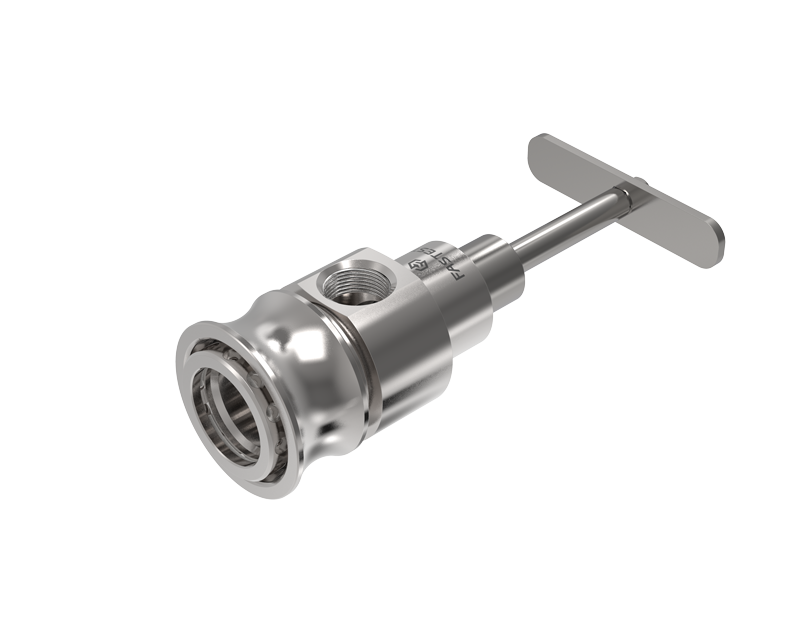
The NEW PortMax™ access port system is specifically designed to reduce processing time, in particular, evacuation time (degass/dehydrate) of large volume refrigerant systems currently processing through packed angle or ball valves.
Evacuation Tool (CMFT80)
Ball latching connector with sliding TEE handle mechanism. Retracts out of flow path for maximum evacuation. Torques Plug to seal system.
- Ball latching connector without an internal valve for high flow
- Ergonomic ball & sleece action. Safety Latch system will not disconnect under pressure
- 1/2 NPT media port
PortMax™ Brochure: Click Here
PortMax™ Evacuation Tool Operating Instructions: Click Here
PortMax™ Evacuation Tool Rebuild/Seal Replace Instructions: Click Here
PortMax™ System Guide: Click Here
Similar Products
PortMax™ | Refrigerant Access Ports
Large-capacity refrigerant access port system designed to reduce evacuation time and maximize processing flow.
PortMax™ | Leak Test Tool
High-flow tool for fast repeatable leak testing through PortMax™ | access ports.
PortMax™ | Charge Tool
High-flow charging tool for efficient refrigerant charging through PortMax™ | access ports.
PortMax™ | Service Tool
Field service tool for fast connection to PortMax™ | access ports during maintenance and recovery.
Maximum Conductance — the Tool Gets Out of the Way So Large Systems Evacuate Fast
The FasTest PortMax™ Evacuation Tool (CMFT80) is the evacuation tool of the PortMax™ system — the large-capacity access port system built to cut the evacuation time of large-volume refrigerant systems. Its whole design is aimed at one thing: conductance, the ease with which gas flows out of the system under vacuum. The higher the conductance, the faster a large system degasses and dehydrates.
Three design choices maximise it. The tool has no internal valve, so there is nothing in the flow path to restrict it. Its mechanism physically retracts out of the flow path during evacuation, opening the largest possible passage. And it uses a large 1/2 NPT media port — double the port size of the ZeroMax™ tools — to carry that flow. On a large-volume system, where evacuation is often the single longest step, an unobstructed high-conductance path is what turns hours of pump-down into less.
This matters most against what PortMax™ replaces. Large refrigerant systems are frequently processed through packed angle valves or ball valves, which are convenient service fittings but restrictive flow paths — slow to evacuate through. PortMax™ is specifically designed to displace those, and the evacuation tool is where the time saving is realised: degassing and dehydration through a high-conductance PortMax™ port rather than a throttled valve.
The tool also seals the system: after evacuation, it torques the Plug into the port to close it. A ball latching connector with a sliding TEE handle mechanism makes the connection and drives the sequence, and a safety latch prevents disconnection under pressure. Rated from 20 micron of vacuum to 2031 psi (140 bar), it spans deep-vacuum dehydration through high-pressure work on the same connection.
The Problem the FasTest PortMax™ Evacuation Tool Solves
Evacuating a large-volume refrigerant system is dominated by conductance, and the conventional access methods work against it:
-
Packed angle and ball valves restrict flow: They are handy service fittings but narrow, tortuous flow paths — low conductance, so a large system takes a long time to pull down through them.
-
Large volumes magnify every restriction: The bigger the system, the more the evacuation time depends on the conductance of the path. A restriction that is tolerable on a small system dominates a large one.
-
An internal valve is itself a restriction: Any valve in the tool’s flow path lowers conductance. Removing it, and retracting the mechanism out of the path, opens the passage fully.
-
Deep vacuum for dehydration is conductance-limited: Pulling down to a deep vacuum to remove moisture is exactly where a restrictive path costs the most time.
The FasTest PortMax™ Evacuation Tool answers each: no internal valve, a mechanism that retracts out of the flow path, and a large 1/2 NPT port — maximum conductance for fast degassing and dehydration of large systems — and it torques the Plug to seal the system when evacuation is done.
Key Features
Retracts Out of the Flow Path for Maximum Evacuation
The sliding TEE handle mechanism retracts the tool out of the flow path during evacuation, opening the largest possible passage through the port. Nothing sits in the way of the gas being pulled out, which is the most direct way to raise conductance — and on a large-volume system that is what shortens the pump-down.
No Internal Valve — High Flow
Unlike a tool with an internal valve, the PortMax™ Evacuation Tool has none, so there is no valve restriction in the evacuation path. Combined with the retracting mechanism, the result is an essentially unobstructed high-conductance route from the system to the vacuum source.
Large 1/2 NPT Media Port
The 1/2 NPT media port is twice the size of the 1/4 NPT ports on the ZeroMax™ tools, carrying more flow. Port size is a direct contributor to conductance, and a larger port on a large system is part of why PortMax™ evacuates faster than a small service valve.
Torques the Plug to Seal the System
When evacuation is complete, the tool torques the Plug into the PortMax™ port to seal the system, so evacuation and sealing are handled by the same tool at the same station. (The required plug torque value should be shown on the page; see the note at the end.)
Ball Latching With Sliding TEE Handle, and a Safety Latch
A ball latching connector with a sliding TEE handle makes the connection and drives the retract-and-torque sequence, while an ergonomic ball & sleeve action keeps it quick. A safety latch system prevents disconnection under pressure, so the tool releases only when intended — across a range from 20 micron of vacuum to 2031 psi (140 bar).
Technical Specifications
| Specification | Detail |
|---|---|
| Product Type | High-flow, high-conductance evacuation tool for large-volume refrigerant systems, via PortMax™ access ports. |
| Part Number | CMFT80. |
| Connects To | PortMax™ access ports. |
| Pressure / Vacuum Range | 20 micron of vacuum to 2031 psi (140 bar). |
| Flow Design | No internal valve; mechanism retracts out of the flow path for maximum conductance. |
| Media Port | 1/2 NPT (larger than the 1/4 NPT ZeroMax™ tools). |
| Sealing | Torques the Plug into the port to seal the system. |
| Plug Torque Value | Plug: 12-14 ft-lbs (16-19 N-m) Dust Cap: 12-14 ft-lbs (16-19 N-m) Note: Do not exceed 14 ft-lb (19 N-m) when tightening Plug. Apply counter-torque to Access Port Seat hex when tightening Plug and Dust Cap to prevent imparting stress to brazed joints. |
| Connection | Ball latching connector with sliding TEE handle mechanism; ergonomic ball & sleeve action. |
| Safety | Safety latch system — will not disconnect under pressure. |
| Actuation Type | OEM. |
| Replaces | Packed angle valves and ball valves used to process large-volume refrigerant systems. |
| System Role | One of the PortMax™ tools — alongside the Charge Tool, Leak Test Tool, and Service Tool — all working with PortMax™ Refrigerant Access Ports. |
| Documentation | PortMax™ brochure, Evacuation Tool operating instructions, rebuild / seal replacement instructions, and the PortMax™ System Guide. |
Where the FasTest PortMax™ Evacuation Tool Is Used
Large-Volume Refrigerant System Evacuation
Its core use is evacuating large-volume refrigerant systems — the kind currently served by packed angle or ball valves — where the sheer volume makes conductance the deciding factor in pump-down time. The retract-out-of-path design and large port are aimed squarely at that job.
Degassing and Dehydration
Evacuation here means degassing (removing non-condensable gases) and dehydration (removing moisture) to a deep vacuum before charge. Reaching 20 micron quickly on a large system depends on conductance, which is exactly what this tool maximises.
Sealing After Evacuation
Because the tool torques the Plug into the port to seal the system, evacuation and sealing happen at one station with one tool — the system is pulled down and then closed without a separate sealing operation.
HVAC-R and Large-System Manufacturing
PortMax™ targets larger HVAC-R and refrigerant systems — commercial and industrial air conditioning, refrigeration, and heat pumps — where the volumes are large and evacuation time is a major share of processing time.
FasTest PortMax™ Evacuation Tool vs. a Packed Angle / Ball Valve
| Packed Angle / Ball Valve | PortMax™ Evacuation Tool | |
|---|---|---|
| Flow Path | Narrow, restrictive | Mechanism retracts out of the path |
| Conductance | Low | High — maximised by design |
| Internal Valve | Valve in the path | None — for high flow |
| Port Size | Typically small | Large 1/2 NPT |
| Evacuation Time (large systems) | Long | Reduced |
| Sealing | Separate operation | Torques the Plug to seal |
| Pressure / Vacuum | Varies | 20 micron to 2031 psi (140 bar) |
Frequently Asked Questions
Q: What is the PortMax Evacuation Tool?
A: It is the evacuation tool of the FasTest PortMax™ system, part number CMFT80. It evacuates large-volume refrigerant systems at high conductance through PortMax™ access ports — with no internal valve, a mechanism that retracts out of the flow path, and a large 1/2 NPT port — and then torques the Plug to seal the system.
Q: What does “high conductance” mean here?
A: Conductance is how easily gas flows through a path under vacuum. The higher it is, the faster a system evacuates. The PortMax™ Evacuation Tool maximises conductance by removing the internal valve, retracting its mechanism out of the flow path, and using a large 1/2 NPT port — which is what makes it fast on large-volume systems.
Q: What does “retracts out of flow path” mean?
A: The sliding TEE handle mechanism physically moves the tool’s working parts out of the evacuation passage during pump-down, so nothing obstructs the flow. It is the most direct way to raise conductance and speed evacuation.
Q: What does the tool connect to?
A: PortMax™ access ports — the large-capacity port system designed to reduce evacuation time on large-volume refrigerant systems.
Q: Does the PortMax Evacuation Tool have an internal valve?
A: No — deliberately. Removing the internal valve eliminates a restriction in the flow path, which raises conductance and speeds evacuation. That is why the bullet notes “without an internal valve for high flow.”
Q: Does the tool seal the system too?
A: Yes. After evacuation it torques the Plug into the PortMax™ port to seal the system, so evacuation and sealing are done by the same tool at the same station.
Q: What is the pressure and vacuum range?
A: 20 micron of vacuum to 2031 psi (140 bar) — deep-vacuum dehydration through high-pressure work on the same connection.
Q: What is the part number?
A: CMFT80. Distributors and repeat buyers can search that part number directly for the PortMax™ Evacuation Tool.
Q: How is PortMax different from ZeroMax and CoreMax?
A: All three are FasTest refrigerant access systems. PortMax™ is the large-capacity, high-conductance system for large-volume systems that would otherwise use packed angle or ball valves. ZeroMax™ is the zero-leak, hermetic port that replaces process stub tubes, aimed at flammable-refrigerant safety. CoreMax® is a high-flow serviceable valve core and seat. FasTest’s access-ports overview compares them.
Q: What industries use the PortMax Evacuation Tool?
A: HVAC-R and refrigerant systems — particularly larger commercial and industrial air conditioning, refrigeration, and heat pump systems — where large volumes make evacuation time a major part of processing.