


PortMax™ | Leak Test Tool
High-flow tool for fast repeatable leak testing through PortMax™ | access ports.
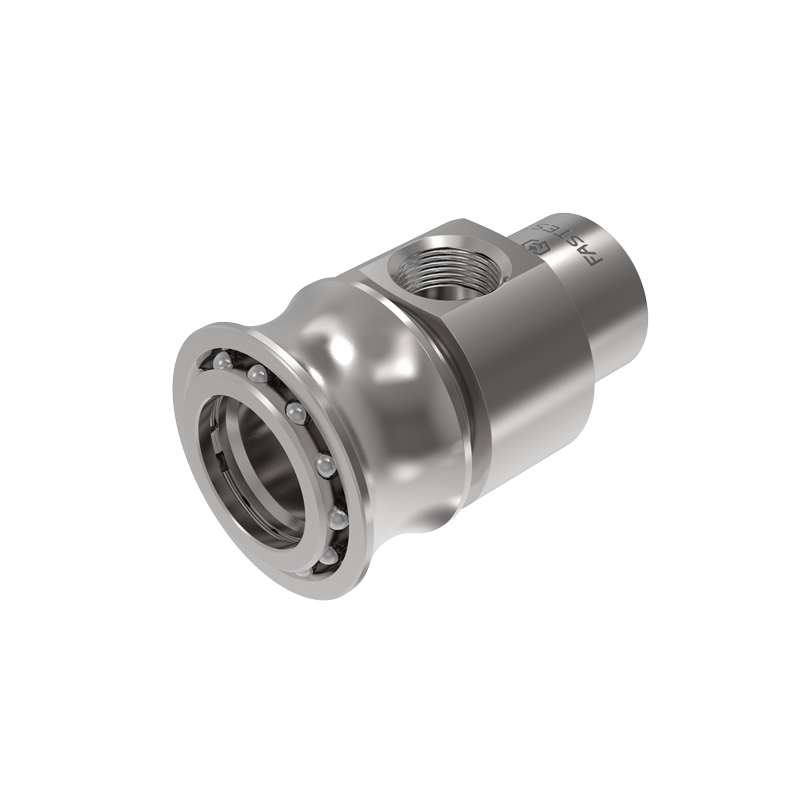
The NEW PortMax™ access port system is specifically designed to reduce processing time, in particular, evacuation time (degass/dehydrate) of large volume refrigerant systems currently processing through packed angle or ball valves.
Leak Test Tool (CMFT60)
Ball latching connector, no TEE handle mechanism (cannot torque Plug)
- Ball latching connector without an internal valve for high flow
- Ergonomic ball & sleeve action. Safety Latch system will not disconnect under pressure
- 1/2 NPT media port
PortMax™ Brochure: Click Here
PortMax™ Leak Test Tool Operating Instructions: Click Here
PortMax™ Leak Test Tool Rebuild/Seal Replace Instructions: Click Here
PortMax™ System Guide: Click Here
Similar Products
PortMax™ | Refrigerant Access Ports
Large-capacity refrigerant access port system designed to reduce evacuation time and maximize processing flow.
PortMax™ | Evacuation Tool
High-flow evacuation tool for faster degassing and dehydration through PortMax™ | access ports.
PortMax™ | Charge Tool
High-flow charging tool for efficient refrigerant charging through PortMax™ | access ports.
PortMax™ | Service Tool
Field service tool for fast connection to PortMax™ | access ports during maintenance and recovery.
The Focused Test Tool — High Flow to Test, and Nothing It Doesn’t Need
The FasTest PortMax™ Leak Test Tool (CMFT60) is the leak-test tool of the PortMax™ system — a high-flow connection for fast, repeatable leak testing through the large-capacity PortMax™ access port. Like the rest of the PortMax™ tools it uses a ball latching connector, has no internal valve, and carries a large 1/2 NPT media port, so the test path is wide open and fast.
What sets it apart from its siblings is what it deliberately leaves out. The Evacuation Tool has a sliding TEE handle that retracts out of the flow path; the Charge Tool has a fixed TEE handle that eliminates pressure loading; both torque the Plug to seal the system. The Leak Test Tool has no TEE handle mechanism at all and, as the page states plainly, cannot torque the Plug. That is by design: leak testing is not a sealing step. The tool connects, the system is pressurized and tested, and the tool disconnects — the Plug is installed and sealed elsewhere in the process. Leaving out the handle and torque mechanism keeps the test tool simple and focused on the one thing it does.
For leak testing, the high-flow, no-internal-valve design is exactly right. A leak test is a cycle of pressurizing and relieving, and the faster the system reaches test pressure and vents, the shorter the cycle — so an unobstructed path with a large port makes fast, repeatable testing possible on a large-volume system. It is the same reasoning behind FasTest’s other high-flow leak test tools, applied to the large PortMax™ port.
A safety latch system prevents the tool from being disconnected while the system is under pressure — the essential feature on a leak test station, where the unit is deliberately held at test pressure. The tool spans 20 micron of vacuum to 2031 psi (140 bar), and connects with an ergonomic ball & sleeve action for the volumes a test station runs.
The Problem the FasTest PortMax™ Leak Test Tool Solves
Leak testing a large-volume refrigerant system, in production, raises problems the PortMax™ Leak Test Tool is shaped to solve:
-
Restriction slows the test: A leak test pressurizes and relieves on every unit. A valve or narrow path lengthens both steps, so the tool is valveless with a large 1/2 NPT port — high flow, fast cycle.
-
The connection must hold at test pressure: Leak testing holds the system at pressure by definition. A connection that could release mid-test is a hazard and a failed test, so the safety latch keeps it locked on.
-
A test tool should not do a sealing tool’s job: Adding a plug-torque mechanism the test step never uses would only add cost and complexity. The Leak Test Tool omits it deliberately — it tests, and sealing is handled by the evacuation or charge tool that torques the Plug.
-
High volume needs a fast, repeatable connection: On a line testing every unit, the connection must be quick and consistent — hence ball latching and the ergonomic ball & sleeve action.
The FasTest PortMax™ Leak Test Tool answers each: a valveless, large-port, high-flow design for fast pressurize-and-relieve, a safety latch that holds under pressure, and a focused build that does testing and leaves sealing to the tools meant for it.
Key Features
No TEE Handle — a Focused Test Tool (Does Not Torque the Plug)
Unlike the Evacuation and Charge tools, the Leak Test Tool has no TEE handle mechanism and cannot torque the Plug. This is intentional. Leak testing is a connect-pressurize-test-disconnect operation, not a sealing operation, so the tool that does it has no need to install or torque the Plug. Omitting the mechanism keeps the tool simpler and purpose-built for testing; sealing the system is done by the tool designed for it. Stating this clearly also helps a buyer pick the right PortMax™ tool for each station.
Valveless, High Flow
A ball latching connector with no internal valve gives an unobstructed flow path. In leak testing that means the system reaches test pressure quickly and relieves quickly, keeping the pressurize-and-relieve cycle short on a line where every unit is tested.
Large 1/2 NPT Media Port
The 1/2 NPT media port carries the test medium at high flow — the same large port the other PortMax™ tools use, and part of why testing a large system through a PortMax™ port is faster than through a small service valve.
Safety Latch — Will Not Disconnect Under Pressure
The safety latch system prevents the tool from being disconnected while the system is under pressure. On a leak test station, where the unit is held at test pressure throughout, that is the feature that keeps the connection secure until the system is relieved.
Fast, Repeatable Ball Latching Connection
A ball latching connector with an ergonomic ball & sleeve action makes the connection quick and consistent, suited to the volume of a test station that checks every unit.
Technical Specifications
| Specification | Detail |
|---|---|
| Product Type | High-flow leak test tool for large-volume refrigerant systems, via PortMax™ access ports. |
| Part Number | CMFT60. |
| Connects To | PortMax™ access ports. |
| Pressure / Vacuum Range | 20 micron of vacuum to 2031 psi (140 bar). |
| Flow Design | No internal valve, for high flow. |
| Media Port | 1/2 NPT. |
| Handle / Sealing | No TEE handle mechanism — does not torque the Plug (test tool only; sealing is handled by the evacuation or charge tool). Intentional, not a limitation. |
| Connection | Ball latching connector; ergonomic ball & sleeve action. |
| Safety | Safety latch system — will not disconnect under pressure. |
| Actuation Type | OEM. |
| System Role | One of the PortMax™ tools — alongside the Evacuation Tool, Charge Tool, and Service Tool — all working with PortMax™ Refrigerant Access Ports. |
| Documentation | PortMax™ brochure, Leak Test Tool operating instructions, rebuild/seal replacement instructions, and the PortMax™ System Guide. |
Where the FasTest PortMax™ Leak Test Tool Is Used
OEM Leak Test Stations
Its core use is the leak test station on a production line: latch onto the PortMax™ port, pressurize with the test medium, hold and measure, then relieve and disconnect. The valveless, large-port design keeps the pressurize-and-relieve cycle short across every unit tested.
Pressure and Proof Testing
For pressure and proof testing, the safety latch lets the system be taken to and held at test pressure with the tool locked on, released only once the system is relieved.
High-Volume Testing of Large Systems
On large-volume systems, the high-flow path shortens the time to reach and relieve test pressure, which matters most where the volume is large and every unit is tested.
HVAC-R and Large-System Manufacturing
PortMax™ targets larger HVAC-R and refrigerant systems — commercial and industrial air conditioning, refrigeration, and heat pumps — where leak testing large volumes benefits from a high-flow connection.
FasTest PortMax™ Leak Test Tool vs. a Packed Angle / Ball Valve
| Packed Angle / Ball Valve | PortMax™ Leak Test Tool | |
|---|---|---|
| Flow Path | Restrictive | Valveless — high flow |
| Time to Test Pressure | Slower | Faster — large 1/2 NPT port |
| Relieving Test Medium | Slower | Faster — high flow |
| Under Pressure | May be released | Safety latch — will not disconnect |
| Connection | Thread / varies | Ball latching, ergonomic |
| Repeatability | Slower per cycle | Fast, repeatable at every unit |
| Pressure / Vacuum | Varies | 20 micron to 2031 psi (140 bar) |
Frequently Asked Questions
Q: What is the PortMax Leak Test Tool?
A: It is the leak-test tool of the FasTest PortMax™ system, part number CMFT60. A ball latching connector with a valveless, high-flow design and a large 1/2 NPT port, it makes fast, repeatable leak test connections to PortMax™ access ports on large-volume refrigerant systems.
Q: Why is the Leak Test Tool valveless and high flow?
A: Because a leak test pressurizes and relieves on every unit, and a valve or narrow path slows both. A valveless path with a large 1/2 NPT port lets the system reach test pressure and vent quickly, which keeps the cycle short on a line where every unit is tested.
Q: Why can’t the Leak Test Tool torque the Plug?
A: By design. Leak testing is a connect-pressurize-test-disconnect operation, not a sealing operation, so this tool has no TEE handle mechanism and does not torque the Plug. Sealing the system — torquing the Plug into the port — is done by the PortMax™ evacuation or charge tool. Leaving the mechanism out keeps the test tool simple and focused.
Q: What does the Leak Test Tool connect to?
A: PortMax™ access ports — the large-capacity port system that the whole PortMax™ tool set works with.
Q: Can it disconnect under pressure?
A: No. The safety latch system prevents disconnection while the system is under pressure, which is essential on a leak test station where the unit is held at test pressure.
Q: What is the pressure and vacuum range?
A: 20 micron of vacuum to 2031 psi (140 bar).
Q: How do the three PortMax processing tools differ?
A: They share the high-flow PortMax™ platform but are tuned to their jobs. The Evacuation Tool (CMFT80) has a sliding TEE handle that retracts out of the flow path for maximum conductance under vacuum, and torques the Plug to seal. The Charge Tool (CMFT70) has a fixed TEE handle that eliminates pressure loading for charging under pressure, and also torques the Plug. The Leak Test Tool (CMFT60) has no TEE handle and does not torque the Plug — it is the focused test connection. All three are valveless, use a 1/2 NPT port, and have a safety latch.
Q: What is the part number?
A: CMFT60. Distributors and repeat buyers can search that part number directly for the PortMax™ Leak Test Tool.
Q: How is PortMax different from ZeroMax and CoreMax?
A: All three are FasTest refrigerant access systems. PortMax™ is the large-capacity, high-flow system for large-volume systems that would otherwise use packed angle or ball valves. ZeroMax™ is the zero-leak, hermetic port that replaces process stub tubes, aimed at flammable-refrigerant safety. CoreMax® is a high-flow serviceable valve core and seat. FasTest’s access-ports overview compares them.
Q: What industries use the PortMax Leak Test Tool?
A: HVAC-R and refrigerant systems — particularly larger commercial and industrial air conditioning, refrigeration, and heat pump systems — where large volumes make a high-flow leak test connection worthwhile.